Inside the Noise: How Narrative Became the New Risk Domain.

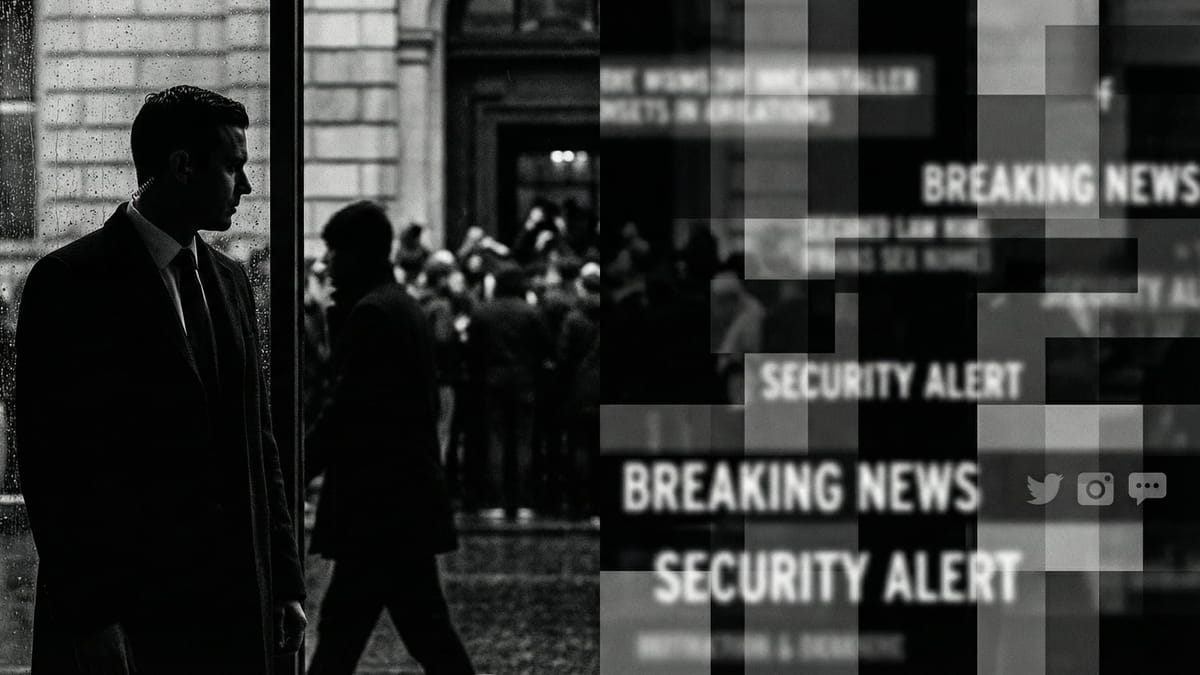
Storytelling has evolved from a branding tool into a strategic shield in contested perception spaces.
It started with a Wall Street Journal article about companies paying serious money for storytellers. Most mornings, when I don’t work out, I meditate, then have my coffee and read the news. This one got my attention and my brain fired off. (The Wall Street Journal)
On the surface, it sounded like another marketing trend headline: brands chasing authenticity and human connection in an attention-starved online world. But for anyone who has worked in intelligence, diplomacy, or protection, the signal reads differently. The rise of storytelling as a business function is not just about branding. It is about narrative becoming a strategic operating layer.
In a saturated information environment, storytelling has evolved from decoration to defense. The same emotional levers that make a message feel trustworthy also make it effective at manipulation. Influence is influence, and the difference between persuasion and subversion lies less in method than in motive.
The dual use nature of influence
Professionals in security and information operations recognize this pattern immediately: the mechanics of influence do not change across domains. Emotional resonance, repetition, identity cues, and social proof fuel the same mental shortcuts that shape belief and behavior, whether that behavior is clicking “add to cart” or showing up in the street. The dividing line is intent, constraint, and tolerance for harm.
Commercial influence seeks conversion: buy, subscribe, apply.
Sharp power seeks control: polarize, exhaust, delegitimize, recruit.
Same engine, different destination. Recognizing that distinction is the essence of narrative situational awareness, a skill increasingly essential not just for political analysts or media strategists, but for operators and executives who must navigate contested perception spaces.
The campfire never left, it just scaled
I wrote in the article “Stories That Kill, Stories That Protect” about the campfire and the sharing of stories. Stories did not begin with social media. They began around the fire. That was the inception phase of group behavior. Stories were told, emotions got triggered, meaning was assigned, and then action followed, for better or worse. The campfire was a technology for shared reality.
Today we carry that campfire in our pockets. We are connected but not connected. We share networks, not understanding. We have constant exposure without stable shared context. Stories travel faster than corrections, and feelings often arrive before facts. In that environment, “relatable” is not just a creative choice. It can become a weaponizable feature.
The hybrid zone: where domains overlap
This is what makes the current environment hybrid. Not hybrid as a buzzword, but hybrid as overlapping domains. Cyber, physical, informational, diplomatic, economic, legal, social. They no longer sit in separate lanes. A narrative can trigger online targeting, which triggers doxxing, which triggers physical harassment, which forces a security posture change, which becomes news, which feeds the narrative again. One loop, multiple domains.
In that hybrid zone, close protection is not only about routes and distances. It is also about exposure created by digital traces, by reputational frames, and by the speed at which stories jump from screen to street. In hybrid environments, the story is often the bridge between domains.
When risk arrives as perception
One lesson repeats: risk doesn’t only arrive as capability. It arrives first as mood. You can feel safe and still be exposed, because risk can be invisible. And you can feel threatened without a direct threat, because perception reacts to uncertainty, rumor, and social cues. The danger is the gap between perceived safety and actual exposure.
Storytelling operates at that level, before people even think it through. The micro-narratives, small talk, gossip, insider jokes, unspoken looks, are often the first sensors of change. They can reveal environmental temperature more reliably than a thousand datasets. The right narrative can reduce friction and stabilize judgement. The wrong one can ignite escalation faster than logistics can respond.
For practitioners, this means narrative intelligence is now a core security function. Storylines can act as early warning systems. Crowd moods and online frames can shift exposure profiles long before physical risk manifests.
Overload as a risk factor
We tend to associate intelligence failure with absence: missing a clue, lacking visibility. Increasingly, the opposite is true. Systems fail from saturation. Too much information dilutes focus, fragments verification, and overclocks attention. In that environment, storytelling becomes a form of triage, the means by which meaning is reintroduced into chaos. It answers, implicitly or explicitly: what matters, what can wait, who is credible, what is noise.
The challenge is that, when coordinated actors are present, hostile narratives can exploit this bandwidth strain. They seed doubt, amplify emotional content, and capitalize on accelerated reaction loops. Noise itself becomes a weapon. Filtering, not just gathering, becomes both an operational discipline and a cognitive discipline.
Diplomacy and the narrative chessboard
Diplomacy, at its core, is narrative under uncertainty. You shape conditions where decisions feel legitimate and cooperation feels safe. That’s soft power in action. As Joseph Nye puts it, “Soft power is the ability to get what you want through attraction rather than coercion or payments.” (Gupta, 2022). Attraction built on coherence and credibility is the point.
But the same channels that enable soft power are open to sharp power, operations designed not to convince, but to confuse. The aim isn’t consensus, but corrosion. When trust erodes, structure follows.
The intersection between commercial communication, political persuasion, and influence operations now sits in a single volatile ecosystem. Companies and states alike compete for narrative legitimacy, not just to win markets or elections, but to preserve the operating environment of trust.
The convergence of marketing, politics, and security
Seen through that lens, the WSJ trend makes a deeper kind of sense. Corporations are not suddenly becoming poetic. They’re reacting to an altered operating environment. Authenticity isn’t just a marketing virtue. It’s a trust trigger in a distrust economy. (The Wall Street Journal)
When perception shapes action, a company’s story becomes part of its security perimeter. Narrative resilience, the ability to stabilize belief under pressure, now sits alongside cyber hygiene and physical protection as part of holistic risk management.
In the end, the storytellers companies hire today are not just brand architects. They are, knowingly or not, navigators of cognitive terrain, shaping the same levers that diplomats and intelligence officers have worked within for decades. Because whether in a boardroom, a ministry, or a crisis zone, the rule holds: people act on the story they believe they’re in.
And in the end, we are all in a story. In our own story, in someone else’s story, and sometimes in a story we never agreed to join. In shifting domains, protection is partly about knowing which story you are in, who is writing it, and what it is trying to make you do.
My take: "In a world where stories move faster than facts, awareness of the narrative domain isn’t optional. It’s operational literacy."
Further reading list
The links below are only a small selection and mainly meant as an entry point. I strongly encourage readers to explore the wider literature on narrative, influence, and strategic communications across security studies, psychology, diplomacy, and media research, and to compare definitions and frameworks across disciplines and institutions.
Storytelling and the corporate shift
- Deighton, Katie (2025). “Companies Are Desperately Seeking ‘Storytellers’.” The Wall Street Journal, December 12. (The Wall Street Journal)
Soft power, sharp power, and strategic influence
- Nye, Joseph S., Jr. (2004). Soft Power: The Means to Success in World Politics. PublicAffairs. (ciaotest.cc.columbia.edu)
- Gupta, A. (2022) ‘Panda Power? Chinese Soft Power in the Era of COVID-19’, PRISM, 10(1). National Defense University Press, 30 September. Available at: https://ndupress.ndu.edu/Media/News/News-Article-View/Article/3174587/panda-power-chinese-soft-power-in-the-era-of-covid-19/
- National Endowment for Democracy (2017). Sharp Power: Rising Authoritarian Influence (full report). (NATIONAL ENDOWMENT FOR DEMOCRACY)
Disinformation models and “information disorder”
- Paul, Christopher, and Miriam Matthews (2016). The Russian “Firehose of Falsehood” Propaganda Model: Why It Might Work and Options to Counter It. RAND. (rand.org)
- Wardle, Claire, and Hossein Derakhshan (2017). Information Disorder: Toward an Interdisciplinary Framework for Research and Policy Making. Council of Europe. (edoc.coe.int)
Psychology of persuasion and belief formation
- Cialdini, Robert B. (1984). Influence: The Psychology of Persuasion. (Often cited via later revised editions, for example 2006.) (Goodreads)
- Kahneman, Daniel (2011). Thinking, Fast and Slow. Farrar, Straus and Giroux.
- Sunstein, Cass R. (2017; new edition 2018). #Republic: Divided Democracy in the Age of Social Media. Princeton University Press. (Goodreads)
Intelligence, warning, and overload
- National Commission on Terrorist Attacks Upon the United States (2004). The 9/11 Commission Report.
- Betts, Richard K. (1983). “Warning Dilemmas: Normal Theory vs. Exceptional Theory.” Orbis (Winter 1983). (siwps.org)